
Polonnaruwa became the island’s capital following the fall of the Kingdom of Anuradhapura. King Vijayabahu I established this city as his seat of power after successfully driving out the Chola invaders. Under the reign of several notable monarchs, Anuradhapura had prospered, and the nation gradually strengthened and stabilized.
The Golden Age of Polonnaruwa began with the rise of King Parakramabahu I to the throne. Determined to harness every drop of rainfall, he developed extraordinary irrigation systems that continue to impress even today. Cultivating rice in the arid regions was no easy task, yet the visionary king transformed the challenge into a triumph. One of the era’s most remarkable achievements was the creation of the vast ‘Parakrama Samudra’ (Sea of Parakrama), a reservoir that still shines like a symbol of hope in the heart of Polonnaruwa.
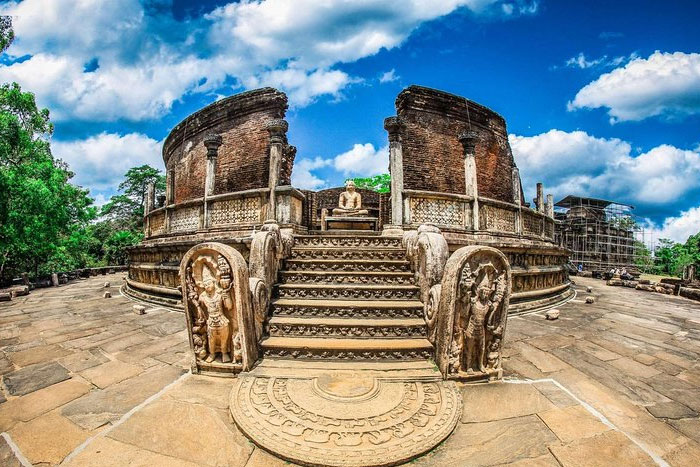
This period also saw the construction of impressive architectural landmarks. Visitors to Polonnaruwa can enjoy exploring the city’s magnificent monuments, which remain a major attraction. The Ancient City of Polonnaruwa is recognized as a UNESCO World Heritage Site, and notable structures such as the Polonnaruwa Vatadage, Gal Vihara, Nissanka Latha Mandapaya, RankothVehera, and Hatadage can be explored either on foot or by bicycle.
A visit to the Polonnaruwa Museum offers a captivating glimpse into the city’s history and the legacies left by its great kings. Among the ruins, large families of toque macaques (monkeys) also thrive, adding a lively charm that fascinates visitors as much as the monuments themselves. Polonnaruwa became the island’s capital following the fall of the Kingdom of Anuradhapura. King Vijayabahu I established this city as his seat of power after successfully driving out the Chola invaders. Under the reign of several notable monarchs, Anuradhapura had prospered, and the nation gradually strengthened and stabilized.
The Golden Age of Polonnaruwa began with the rise of King Parakramabahu I to the throne. Determined to harness every drop of rainfall, he developed extraordinary irrigation systems that continue to impress even today. Cultivating rice in the arid regions was no easy task, yet the visionary king transformed the challenge into a triumph. One of the era’s most remarkable achievements was the creation of the vast ‘Parakrama Samudra’ (Sea of Parakrama), a reservoir that still shines like a symbol of hope in the heart of Polonnaruwa.
This period also saw the construction of impressive architectural landmarks. Visitors to Polonnaruwa can enjoy exploring the city’s magnificent monuments, which remain a major attraction. The Ancient City of Polonnaruwa is recognized as a UNESCO World Heritage Site, and notable structures such as the Polonnaruwa Vatadage, Gal Vihara, Nissanka Latha Mandapaya, RankothVehera, and Hatadage can be explored either on foot or by bicycle.
A visit to the Polonnaruwa Museum offers a captivating glimpse into the city’s history and the legacies left by its great kings. Among the ruins, large families of toque macaques (monkeys) also thrive, adding a lively charm that fascinates visitors as much as the monuments themselves.