
Galle Dutch Fort
History of the Galle Dutch Fort
The Galle Dutch Fort is a remarkable seventeenth-century coastal stronghold located in southern Sri Lanka. Built on a rocky headland overlooking the Indian Ocean, the fort is naturally protected by rugged cliffs on the seaward sides and massive defensive walls on land. Galle was first selected as a permanent commercial base by the Portuguese in 1588. However, after the siege of 1640, Dutch forces captured the fort and expelled the Portuguese from the southern regions of the island.
Under Dutch East India Company (VOC) control, the fort underwent extensive expansion and reinforcement until 1729. Most of the fort’s existing layout and defensive structures date from this period, which is why it is commonly known as the Galle Dutch Fort. During its peak, the fort functioned as the VOC’s principal administrative and military center in southern Sri Lanka, alongside other strategic cities such as Colombo, Trincomalee, and Jaffna.
The fort protected the main southern trading harbor of the VOC. In 1796, control of Galle Fort was transferred peacefully to the British, who retained a military presence there until Sri Lanka gained independence in 1948. After the country became a republic in 1972, many European residents left the fort, and the buildings gradually fell into disrepair. Restoration efforts began after the devastating tsunami in 2004 and gained momentum following the end of the civil conflict in 2009.
Today, Galle Dutch Fort is regarded as the finest surviving colonial fortification in South Asia. Much of its original structure remains intact, including a rare Portuguese-era fortification and thirteen Dutch-built bastions, each representing a distinct phase of the fort’s long history.
The fort’s unique fusion of European and Asian architectural styles draws visitors from around the world. Restored colonial houses now accommodate artists, photographers, writers, and architects. Stylish cafés, boutique stores, and heritage hotels add charm to the narrow streets. At the same time, active courts, government offices, schools, trading centers, and historic churches continue to give the fort a lively and authentic character reminiscent of its colonial past.
The Bastion Walk
Encircling the fort is an approximately three-mile walkway along the ramparts, punctuated by a series of bastions. About three-quarters of this path overlooks the ocean, offering sweeping views of the Indian Ocean. The most prominent bastions on the landward side are Star, Moon, and Sun. These structures feature two levels of defense: a lower tier designed for close-range artillery and an upper level for long-range cannons.
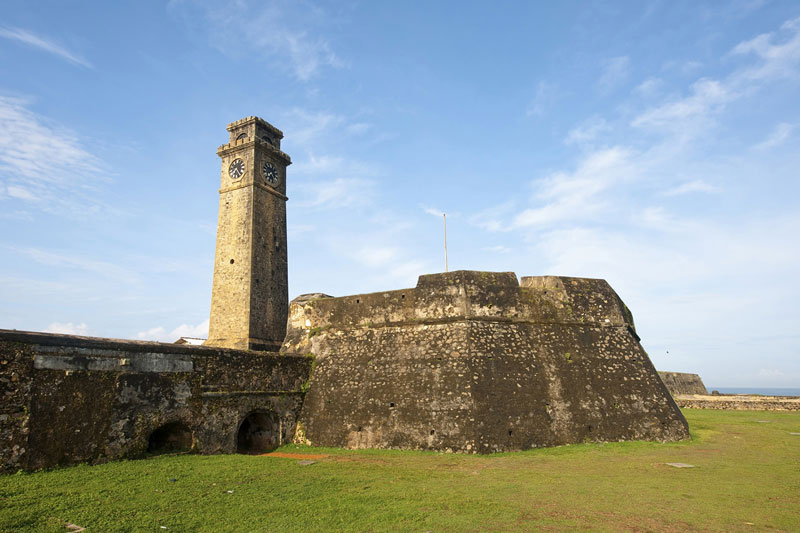
The Moon Bastion, also known as the Mark Bastion, is the largest and most strategically important of the three. It once housed nineteen cannons to protect the fort from land-based attacks. A Victorian-era clock tower, added later, stands atop the bastion and remains one of the fort’s most recognizable landmarks. The tower is over 130 years old.
Continuing along the ramparts, visitors encounter the bastions of Fishmark, Commandment, Black Fort (Zwart), Akersloot, Aurora, Point Utrecht, Flag Rock, Triton, Neptune, Clippenberg, Aeolus, and Star, in sequence. The Black Fort is of particular significance, as it is a Portuguese-era fortification and the oldest surviving structure within the fort.
Between the Moon and Sun Bastions lies the Main Gate, constructed by the British in 1873 to improve access to the fort. This gateway replaced the earlier Dutch gate built in 1668. Inside the gate, a small traffic circle branches into three main roads that organize the fort’s neatly planned street network. The road to the left leads to several notable colonial-era landmarks.
Dutch Reformed Church (Groote Kerk)
Built in 1755, the Dutch Reformed Church occupies the highest elevation within Galle Fort, standing 12 meters above sea level. Its layout follows a Greek cross design and features Doric architectural elements similar to Colombo’s Wolvendaal Church. During the British period, the interior was significantly altered, with additions such as stained-glass windows, an altar, communion rails, a side canopy, and an organ installed in 1760.
All Saints’ Church, Galle
All Saints’ Church is an Anglican place of worship dating back to 1871. Constructed in the Victorian Gothic Revival style, the church follows a basilica plan well suited to the tropical climate. Designed by architect J. G. Smithers, the site was formerly used as a gallows during early Dutch rule. The use of locally sourced laterite stone (kabok) in the arches adds a distinctive regional touch to the structure.
National Maritime Museum, Dutch Warehouse, and Old Gate
The National Maritime Museum is housed in a seventeenth-century Dutch warehouse built directly into the fort’s ramparts, facing the historic harbor. Designed to withstand direct cannon fire, the building features thick walls and sturdy pillars. Inside, the museum displays artifacts related to Sri Lanka’s maritime heritage.
The original entrance to the fort, known as the Old Gate, runs through the warehouse. Above the gate are two coats of arms: the Dutch emblem on the inner side of the fort and the British emblem facing the harbor, symbolizing the fort’s layered colonial history.
Galle Lighthouse and Lighthouse Beach
The current Galle Lighthouse, constructed in 1939, stands on the Point Utrecht Bastion. Rising 92 feet above ground, it serves as a prominent coastal landmark. Adjacent to the lighthouse is Lighthouse Beach, which during the Victorian era was reserved exclusively for women. A shaded courtyard connects the beach area to the Old Dutch Hospital complex.
Flag Rock Bastion
Located at the southernmost edge of the fort, Flag Rock Bastion once functioned as a signaling point for ships entering Galle Harbor. Built atop a natural rock formation, it offers dramatic views of the sea. Today, it is a popular spot for cliff divers, although the activity is extremely dangerous due to the rough waters below. An earlier wooden lighthouse once stood here but was destroyed by fire in 1930.
Start Your Sri Lanka Adventure Today!
Private drivers, custom tours, and unforgettable experiences with GoMyWay.lk.